Monetization project | corner - Games24x7 | GrowthX
Monetization project | corner
đź“„

Monetization project | corner

Substitute Pricing — what's the AE/buyer paying for instead today?

What are your customers paying for? Not "AI call analytics." They're paying to win more deals and reclaim CRM time, privately — the JTBD.

Where does your product stand out? On the axis incumbents can't price for: adoption. Buyers today pay for licenses reps abandon.

How should you position your product? As the tool you only pay for when it's used — the anti-shelfware coach.

Flexibility / Effort / Pricing of the substitutes

Substitute / Factor

Flexibility to adjust

Needs physical effort?

Pricing

Manual manager coaching

Low — depends on manager's time

High — 1:1s, call reviews

"Free" (hidden cost: manager hours)

Gong

Low — annual contract, platform fee

Low

~$1,360–1,600/user/yr + ~$5K platform fee

Chorus (ZoomInfo)

Low

Low

~$8K/yr for 3 seats, ~$1,200/extra seat

Salesloft / Clari

Low

Low

Per-seat, opaque; Copilot +~$100/user/mo

Avoma

Medium — transparent tiers

Low

$19 / $29 / $39 per seat/mo

Jiminny

Medium — no platform fee

Low

~$85/user/mo (~$1,020/yr)

→ Corner

High — per active seat, monthly

Low

~$1,000–1,200/active seat/yr (₹95K–₹1.14L)

The takeaway for the portfolio: incumbents charge per license and lock you into annual platform fees — you pay whether reps use it or not. Corner charges per active seat, which is both cheaper-feeling to the buyer and structurally aligned with the rep-first promise.


Is my product monetizing? (the litmus test)

The litmus test: "If a successful customer leaves and re-uses your product later, would they pay for it again?"

For Corner — yes, and the answer reveals the model. A rep who's been using Corner and then leaves for a new company wants it on day one at the new job (it's their private edge, not a company tool they tolerate). That "I'd pay to bring it with me" pull is the signal the product is genuinely monetizing — and it's why adoption, not seats sold, is the real revenue engine.

Verdict: Corner is monetizing → so we move to Case 1/Case 2 to sharpen how, then validate with the substitute-pricing framework.


Case 1 — Improve conversion + cross-sell/upsell

(The product is monetizing; the job now is to deepen revenue per account.)

Double down on free-to-paid conversion. The free moment is the AE's first private feedback loop. The conversion lever is the second and third call — once a rep has felt the AHA twice, the wedge to paid is "keep your private coach + unlimited CRM auto-fill."

Increase ARPU via cross-sell / upsell (without breaking rep-first):

Motion

What expands

Why it's on-brand

Seat expansion (land-and-expand)

More reps on the team activate → more active seats

Adoption-led, not a top-down license push

Manager/Enablement tier (cross-sell)

Add coaching dashboards + ramp analytics after reps adopt

Sold to the VP only once reps already trust it

Advanced coaching tier (upsell)

Methodology scorecards (MEDDIC/SPICED), deal-risk alerts

Power-user reps + managers

The sequence matters: expand rep seats first, cross-sell the manager layer second. Selling the manager dashboard before reps adopt is exactly the trap that kills the brand.

Case 2 — GTM communication / value framing

The pricing message must carry the two narratives:

  • To the buyer (VP): "You only pay for reps who actually use it." (Per-active-seat = de-risked spend, directly answering the shelfware fear.)
  • To the user (AE): "Your coach is yours." (Price never implies surveillance or scoring.)

When to charge

(Where in the journey does money enter?)

Charge after the rep's value is proven, not at signup. The free tier carries the AE to the AHA (first private feedback loop); the paywall sits at sustained value — unlimited calls, CRM auto-fill, the second/third loop.

Stage

Frequency

Charge here?

Sign up

One-time

❌ No — free, get to AHA

First feedback loop (AHA)

Day 0–7

❌ No — this is the hook

Habit (3+ calls / unlimited)

Week 2+

✅ Yes — rep paywall

Manager/Enablement layer

Month 1+

✅ Yes — buyer cross-sell

The segmentation grid (where to charge): the high-value, high-adoption quadrant is funded SaaS AEs who are on calls daily — charge them on usage depth. The low-adoption/high-budget quadrant (BFSI/Healthcare) you don't lead with, per the ICP work.


What to charge for (the value metric)

Lever

Could we meter on it?

Verdict

Time (per minute analysed)

Possible

❌ Punishes usage — anti-adoption

Output (per feedback report / CRM autofill)

Possible

❌ Same problem — discourages the habit

Seats (per license)

Standard

⚠️ What incumbents do; rewards shelfware

Active seats (per rep who actually uses it)

âś…

âś… The value metric

Shareability

n/a

(Drives the rep-referral loop, not the price)

Charge per active seat. It's the only metric that ties revenue to the north star (AE DAU:WAU) — Corner makes money exactly when it delivers value, and the buyer never pays for a rep who didn't adopt.

How much to charge

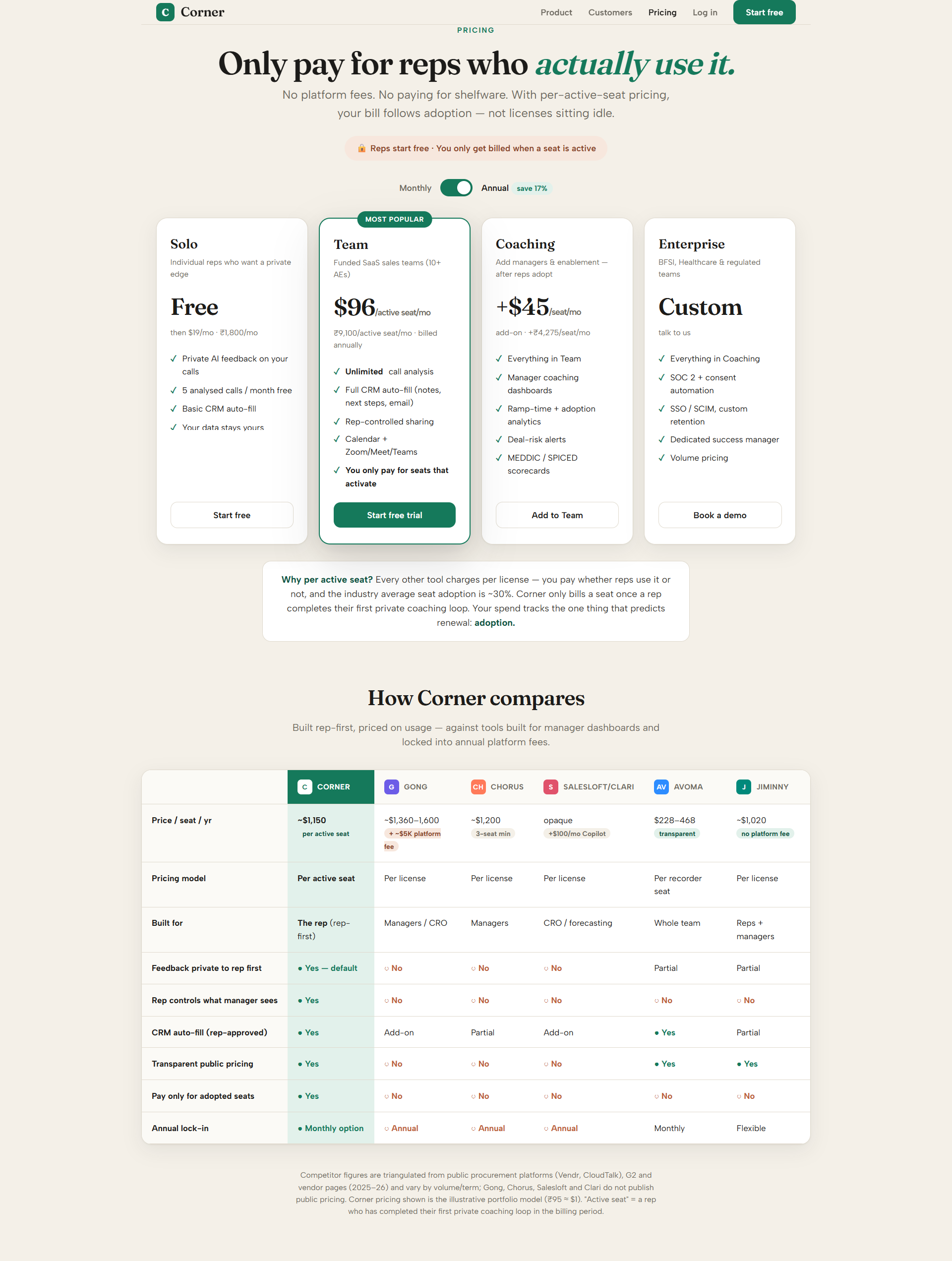
(Per-active-seat, benchmarked between Avoma's value tiers and Gong's premium, ₹95/$.)

Tier

For

Price (USD)

Price (INR)

What's included

Solo (rep self-serve)

Individual AEs

Free → $19/mo

Free → ₹1,800/mo

Private feedback, limited calls, basic CRM auto-fill

Team

Funded SaaS sales teams (core ICP)

~$90–100/active seat/mo (~$1,080–1,200/yr)

~₹8,500–9,500/mo

Unlimited calls, full CRM auto-fill, rep-controlled sharing

Coaching (manager layer)

+ Enablement/Managers

+$40–50/seat/mo add-on

+₹3,800–4,750/mo

Coaching dashboards, ramp analytics, deal-risk

Enterprise

BFSI/Healthcare (later)

Custom

Custom

SOC 2+, consent automation, SSO, custom retention

Anchoring: undercut Gong's ~$1,360–1,600/user/yr and drop the platform fee, while sitting above Avoma's $39 — positioned as "serious coaching, fairly priced, only for seats that use it." The transparent published price is itself a differentiator against incumbent opacity.


Lever

Could we meter on it?

Verdict

Time (per minute analysed)

Possible

❌ Punishes usage — anti-adoption

Output (per feedback report / CRM autofill)

Possible

❌ Same problem — discourages the habit

Seats (per license)

Standard

⚠️ What incumbents do; rewards shelfware

Active seats (per rep who actually uses it)

âś…

âś… The value metric

Shareability

n/a

(Drives the rep-referral loop, not the price)

Charge per active seat. It's the only metric that ties revenue to the north star (AE DAU:WAU) — Corner makes money exactly when it delivers value, and the buyer never pays for a rep who didn't adopt.


(Per-active-seat, benchmarked between Avoma's value tiers and Gong's premium, ₹95/$.)

Tier

For

Price (USD)

Price (INR)

What's included

Solo (rep self-serve)

Individual AEs

Free → $19/mo

Free → ₹1,800/mo

Private feedback, limited calls, basic CRM auto-fill

Team

Funded SaaS sales teams (core ICP)

~$90–100/active seat/mo (~$1,080–1,200/yr)

~₹8,500–9,500/mo

Unlimited calls, full CRM auto-fill, rep-controlled sharing

Coaching (manager layer)

+ Enablement/Managers

+$40–50/seat/mo add-on

+₹3,800–4,750/mo

Coaching dashboards, ramp analytics, deal-risk

Enterprise

BFSI/Healthcare (later)

Custom

Custom

SOC 2+, consent automation, SSO, custom retention

Anchoring: undercut Gong's ~$1,360–1,600/user/yr and drop the platform fee, while sitting above Avoma's $39 — positioned as "serious coaching, fairly priced, only for seats that use it." The transparent published price is itself a differentiator against incumbent opacity.

Pricing Page

image.png

Pricing Rationale — Corner

The value metric: why per active seat

Most monetization mistakes start with charging for the wrong thing. We evaluated four metrics and rejected three:

  • Per minute analyzed / per report—punishes the exact behavior we want. Metering usage taxes the habit (3+ calls in 14 days) that is activation. Rejected.
  • Per license (the incumbent default)—rewards shelfware. The buyer pays whether reps adopt them or not, which is precisely why ~$313K is wasted on unadopted sales tools over two years and seat adoption sits near 30%. Rejected.
  • Per active seat — revenue is recognized only when a rep completes their first private coaching loop. âś…

We charge per active seat because it's the only metric that ties revenue to the north star (AE DAU/WAU). Corner earns when it delivers value, and the buyer never pays for a rep who didn't show up. The pricing model and the product thesis become the same sentence: adoption = value = revenue. That alignment is the whole point — it's rare for a value metric to also be a positioning weapon.

Anchoring: why this number, between Avoma and Gong

The price ladder is built to make the Team tier the obvious choice:

  • Solo (free → $19) de-risks entry and feeds the rep-led, bottom-up motion. "Free" isn't generosity—it's the activation funnel.
  • Team (~$96–115/active seat/mo) is anchored below Gong's ~$1,360–1,600/user/yr and drops the ~$5K platform fee, while sitting above Avoma's $228–468/yr. That band is deliberate: cheap enough to beat the incumbent on total cost, expensive enough to signal "serious coaching, not a $19 notetaker." We're not the cheapest and shouldn't be — Jiminny (~$1,020) proves mid-market will pay for real coaching.
  • Coaching (+$45 add-on) is the cross-sell to the buyer — but priced as an add-on to an already-adopted base, never the entry point. You can only buy the manager layer after reps are active.
  • Enterprise (custom) anchors the ceiling and captures BFSI/Healthcare's higher assurance needs without dragging down the published price.

Why publish the price at all

Gong, Chorus, Salesloft and Clari all hide pricing behind "contact sales." Publishing a transparent Team price is itself a differentiator — it converts the incumbents' opacity into our trust signal, and it lets us rank for "Gong pricing" / "Gong alternative" (real BOFU keywords from the keyword research) on a page that actually answers the question.

The two-narrative discipline, applied to price

  • To the buyer (VP): "You only pay for reps who actually use it." — answers the shelfware fear directly; per-active-seat is de-risked spend.
  • To the rep (AE): "Your coach is yours." — the price never implies scoring, surveillance, or accountability-to-a-manager.

Same page, same number, two reasons to say yes — the same "two narratives that never blur" rule that runs through the whole portfolio.

One honest risk to flag

Per-active-seat introduces revenue unpredictability — if adoption dips, so does the bill, which finance teams dislike. The mitigation: an annual commitment on a baseline of active seats (with true-up for growth), so the buyer gets predictability and Corner still rewards adoption above the floor. Naming this trade-off — rather than pretending the model is free of downsides — is what makes the pricing strategy read as senior PMM work rather than a pitch.


[object Object],[object Object],[object Object],[object Object],[object Object],[object Object],[object Object]

Brand focused courses

Great brands aren't built on clicks. They're built on trust. Craft narratives that resonate, campaigns that stand out, and brands that last.

View all courses

All courses

Master every lever of growth — from acquisition to retention, data to events. Pick a course, go deep, and apply it to your business right away.

View all courses

Courses

Built by Leaders From Amazon, CRED, Zepto, Hindustan Unilever, Flipkart, paytm & more
View All Courses
Advanced Growth Strategy
Brand Led Growth
Creative Strategy
Storytelling
Data Led Growth
Event Led Growth
Partnership Led Growth
Tech for Growth
Go to Market
Growth Model Design

Crack a new job or a promotion with ELEVATE

Designed for mid-senior & leadership roles across growth, product, marketing, strategy & business

View All Resources

Learning Resources

Browse 500+ case studies, articles & resources the learning resources that you won't find on the internet.

Patience—you’re about to be impressed.